Policy networks generated by a diffusion model, running on real hardware.
A latent diffusion model samples the weights of a three-layer MLP policy; the sampled
network is deployed zero-shot on a Unitree G1 with no fine-tuning. In order: walking,
dancing, spin kick.
Abstract
Recent advances in robot learning have driven rapid progress in humanoid control,
enabling increasingly agile behaviors in the real world. However, humanoid control networks are
typically obtained through conventional training procedures, while comparatively little attention
has been given to directly modeling the distribution of their learned weights and generating
functional networks in weight space. In this work, we investigate whether high-performing humanoid
control networks can be generatively modeled directly through their weights. We adopt a latent
diffusion framework that couples a linear autoencoder with a Diffusion Transformer. The autoencoder
compresses actor network parameters into a compact latent space, and the Diffusion Transformer
models the distribution of these latents. Trained on networks collected from reinforcement learning
for the Unitree G1 robot, our approach generates deployable networks that perform various motions
in the real world, including walking, dancing, and spin kick. Beyond generation, we further study
the learned weight space to better understand the structure captured by these humanoid control
networks. We identify a structural principle in the first-layer weights that consistently reflects
the robot's kinematic prior. Notably, this kinematic prior emerges under both Reinforcement
Learning (RL) and Imitation Learning (IL) training, suggesting that it is not specific to a
particular optimization process but may instead reflect common knowledge associated with humanoid
embodiment. Together, these results demonstrate the feasibility of generative modeling in humanoid
network weight space, while providing initial insights into the information encoded by their learned weights.
Method
What we generate? The network weight itself. Diffusion models in robotics normally sample
what the robot should do: an action chunk, a trajectory, a plan. Here the generative
target moves one level up: the model samples the weights and biases of a humanoid control
policy. One sample from the diffusion model is a complete controller, a more fundamental
object than a diffusion policy produces. Once the weights are decoded the diffusion model is
out of the loop entirely: what runs on the robot is a plain policy network at full control
rate.
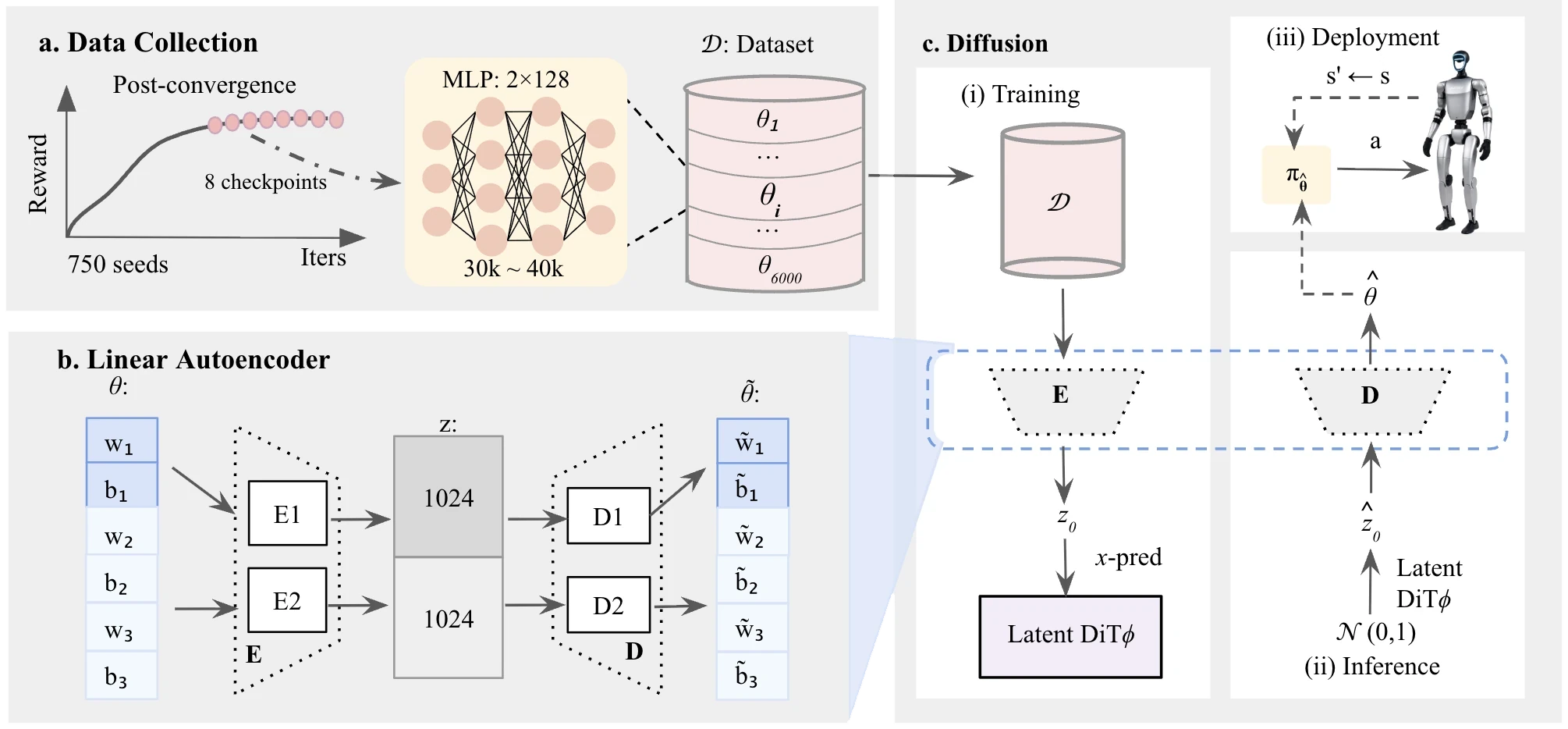
For training data, we run 750 RL runs from scratch with distinct random seeds, and collect
eight network weights after convergence, adding up to 6,000 networks per motion. Each
network is a three-layer MLP, hidden dimensions (128, 128), ELU activations, mapping a 99-d
observation for walking or 154-d for the tracking motions to 29 joint targets, so
roughly 30k–40k parameters each.
How do we diffuse over 30–40k dimensions? Fortunately, we do not have to.
Trained network weights are highly redundant: their effective dimensionality lies far below the
nominal parameter count. We exploit this with a linear autoencoder that compresses the flattened
weights and biases into a 2,048-dimensional latent, and train the diffusion model in that
latent space rather than over the raw parameters.
Method overview. (a) We collect actor weights from 750 training
runs with random seeds and retain eight post-convergence networks from each run. Each network is a
three-layer MLP. (b) The cluster-wise linear autoencoder is implemented using single-layer encoders
and decoders. (c) A diffusion transformer is trained with x-pred loss to model the latent
distribution. During inference, the model generates novel network weights that can be deployed in
the real world.
Experiments
Real-world deployment
Every clip below is a network sampled from the diffusion model and run on the
physical G1 without fine-tuning.
Walkingvelocity-command locomotion
Dancingrhythmic whole-body tracking
Spin kickhighly dynamic kicking motion
Performance evaluation of generated networks
Success rate (Succ) and tracking error (TE) over 100 generated policy networks.
DiT (best 90%) attains performance commensurate with the dataset, indicating that fewer than 10%
of generated samples exhibit performance collapse.
Motion
Dataset
DiT (mean)
DiT (best 90%)
DiT (best)
Succ ↑
TE ↓
Succ ↑
TE ↓
Succ ↑
TE ↓
Succ ↑
TE ↓
Walking
0.999 ± 0.001
0.162 ± 0.003
0.993 ± 0.023
0.191 ± 0.020
0.997 ± 0.003
0.186 ± 0.013
1.000
0.161
Dancing
0.998 ± 0.004
0.037 ± 0.001
0.941 ± 0.213
0.042 ± 0.007
0.996 ± 0.006
0.040 ± 0.003
1.000
0.036
Spin kick
0.997 ± 0.004
0.046 ± 0.002
0.943 ± 0.289
0.053 ± 0.007
0.993 ± 0.009
0.051 ± 0.004
1.000
0.044
Ablation: transformer embedding dimension
Motion
embedding = 512
embedding = 768
embedding = 1024 (ours)
Prog ↑
TE ↓
Prog ↑
TE ↓
Prog ↑
TE ↓
Walking
0.643 ± 0.373
0.513 ± 0.284
0.890 ± 0.253
0.298 ± 0.139
0.997 ± 0.010
0.191 ± 0.020
Dancing
0.536 ± 0.231
0.076 ± 0.012
0.651 ± 0.243
0.071 ± 0.012
0.965 ± 0.154
0.042 ± 0.007
Spin kick
0.296 ± 0.122
0.082 ± 0.008
0.873 ± 0.198
0.067 ± 0.010
0.969 ± 0.136
0.053 ± 0.007
All results are reported as mean ± std over diffusion samples. Prog
is task progress in the range [0, 1]: for motion tracking, it is the fraction of reference
motion frames completed; for walking, it denotes the fraction of the max episode duration
(20 s) survived. TE denotes tracking error: MPKPE (m) for motion tracking, and mean linear
velocity command error (m/s) for walking.
t-SNE visualization
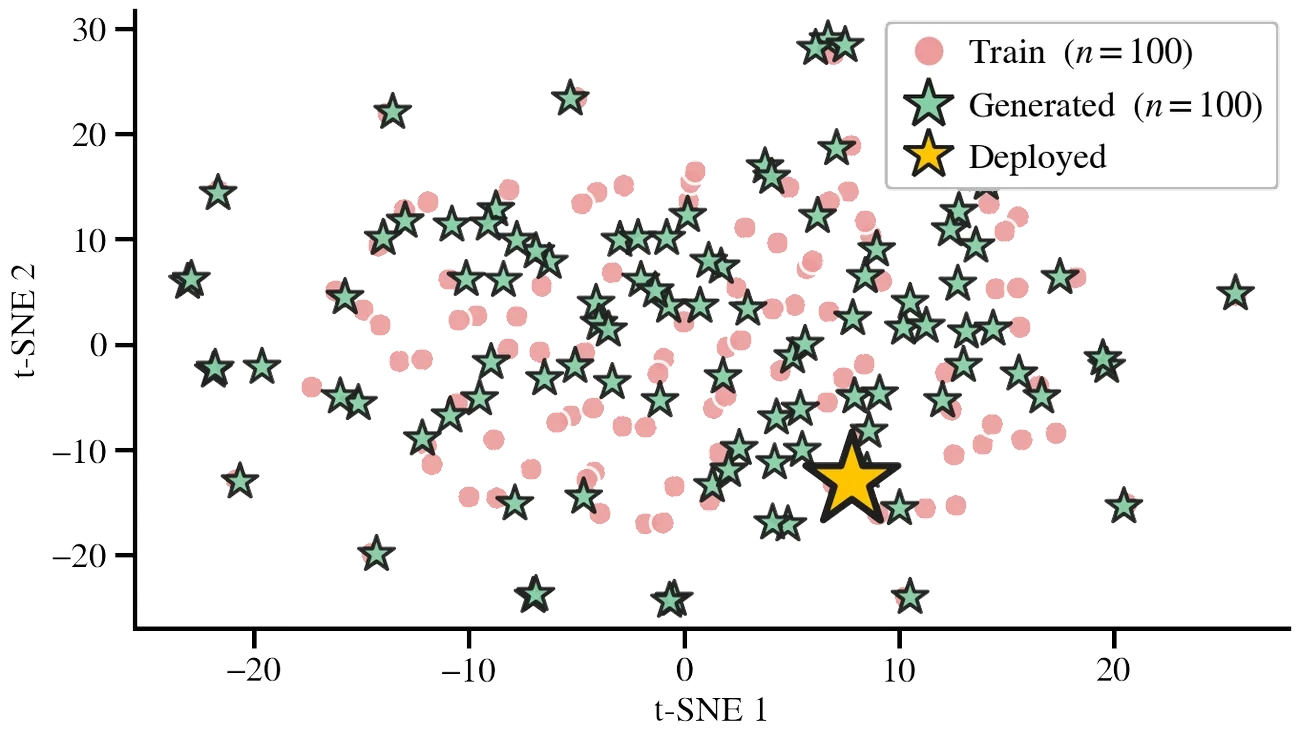
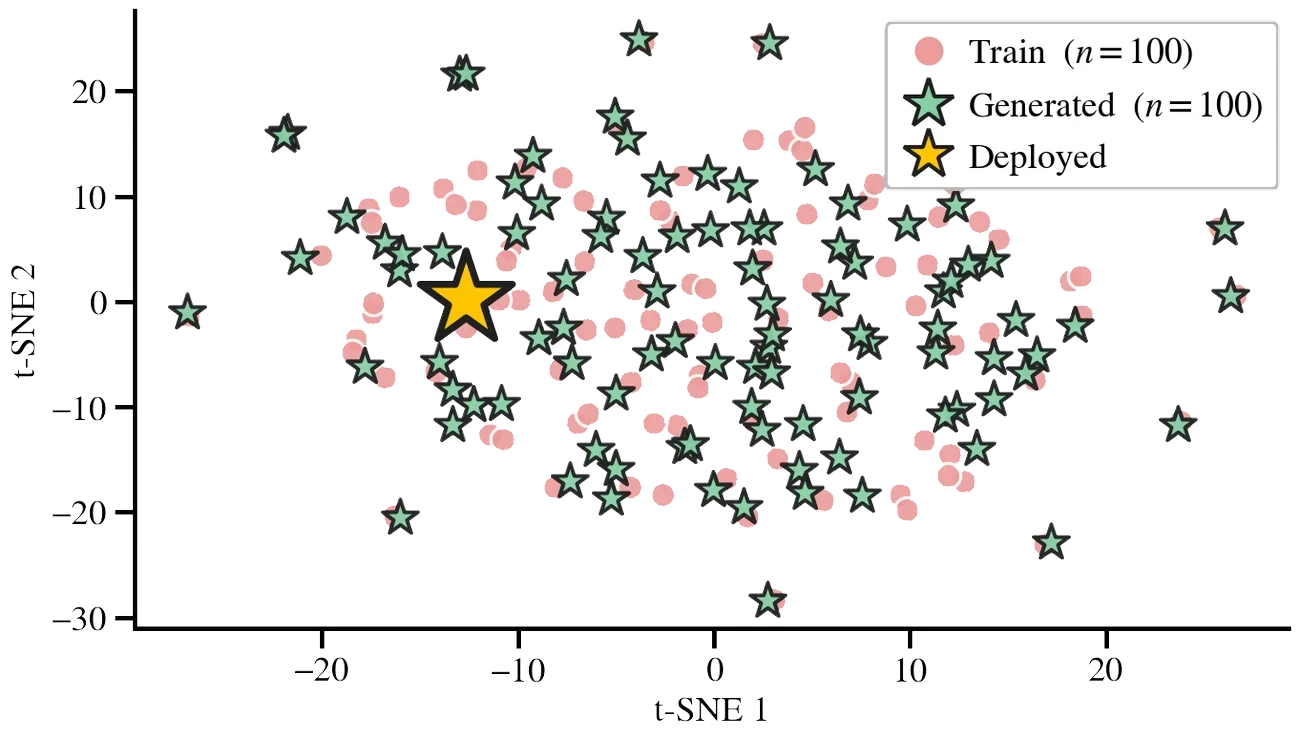
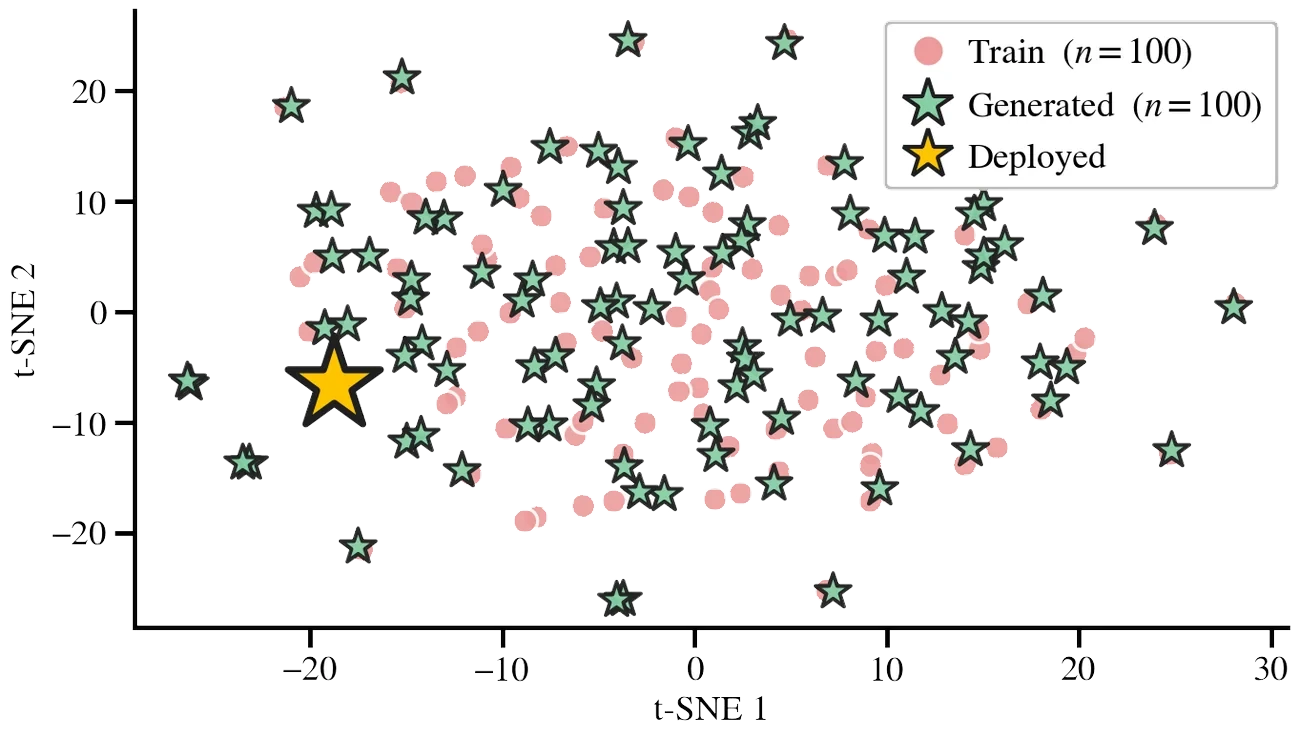
Training and generated weights embedded in a shared t-SNE space, 100
samples each. For all three motions the generated weights fall within the support of the
training distribution, indicating that the two sets are drawn from the same
distribution.
Walkingn = 100 each
Dancingn = 100 each
Spin kickn = 100 each
Memorization or generalization? Not memorization but local generalization.
If the model merely memorized the training set, a generated network should
perform no better than a training network perturbed to the same distance in weight space. We
therefore measure each generated network's distance to its nearest training network, convert this
distance to an equivalent noise level σ, and perturb training networks accordingly. At matched
distances, generated networks consistently outperform the noise-perturbed baselines across all
motions. This indicates that diffusion-generated deviations are structured rather than arbitrary,
preferentially following performance-preserving directions in weight space. We refer to this
behavior as local generalization. Consistently, the rapid performance degradation under increasing
random perturbations shows that comparable displacement alone is insufficient to preserve
functionality.
Noise-perturbed training networkDiffusion-generated (ours)
Success rate against distance from the training set.
The orange line is a training network perturbed by Gaussian noise at increasing σ; the dashed
guide marks the matched distance, where the blue point is the diffusion-generated
network.
Weight Space Analysis
Most studies on RL- or IL-based humanoid and quadruped control primarily
evaluate a policy through its reward, tracking error or other behavioral metrics. In this work, we
instead examine control policies from a complementary perspective: their neural network
weight space. Our diffusion generation results first suggest that this space exhibits
learnable structure,
motivating a further question: what information is encoded in the weight space, and to what extent
is it interpretable? Although the following analysis is preliminary, we view it as a first step
toward understanding the internal organization of neural control networks and toward connecting
weight-space structure with their learned behaviors.
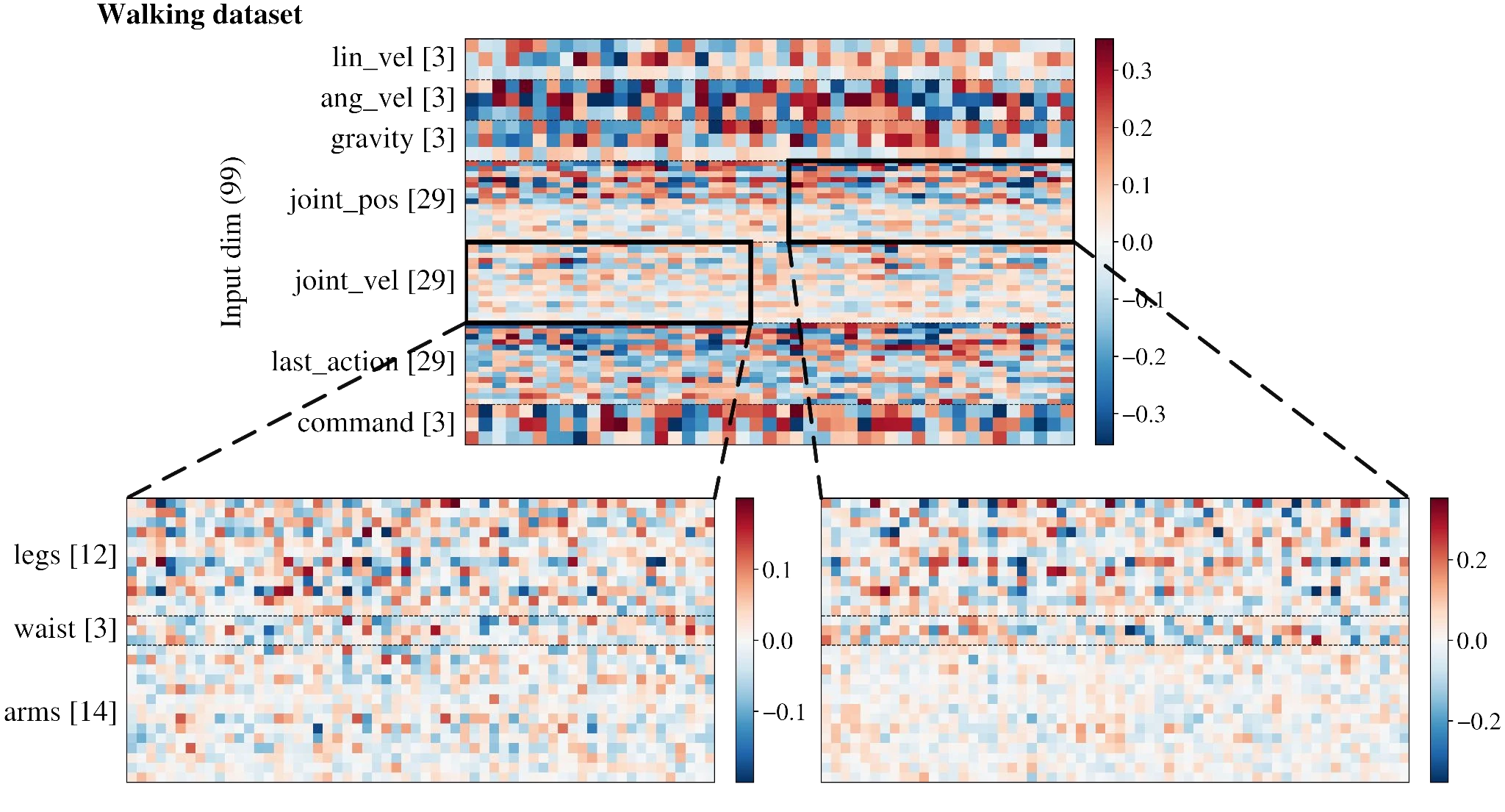
A natural starting point is to directly visualize the weight space structure. Since
the control networks considered here are compact multi-layer perceptrons, we visualize their
weight matrices and biases as heatmaps across three representative motions of increasing
complexity, examining both the first layer and the full network. We further compare networks
trained under RL and IL, as well as RL networks trained with and without domain randomization, to
identify weight space patterns associated with different training paradigms and conditions. To
make weight space magnitudes comparable across observation dimensions, observation normalization
is applied in the RL training used for this analysis, reducing confounding effects caused by
differences in input scale.
To give a better reading experience, the explanatory text under each analysis
below is hidden by default. If you would like to know how an analysis was carried out, just
click See more.
Weight space explorer
We offer comprehensive visualization of the first layer or all three, RL or IL,
with or without domain randomization, one motion or another. Feel free to explore on your own and
find the differences and connections.
It's not difficult to find that the first-layer weights exhibit certain structural
patterns, whereas the second and third layers appear relatively less organized. We hypothesize
that the structure observed in the first layer may be related to the explicit semantic meaning of
the input dimensions, making it more amenable to preliminary analysis. We therefore focus
primarily on the first-layer in the following sections.
15 views · ← → to step through motions
Kinematic prior in the first-layer
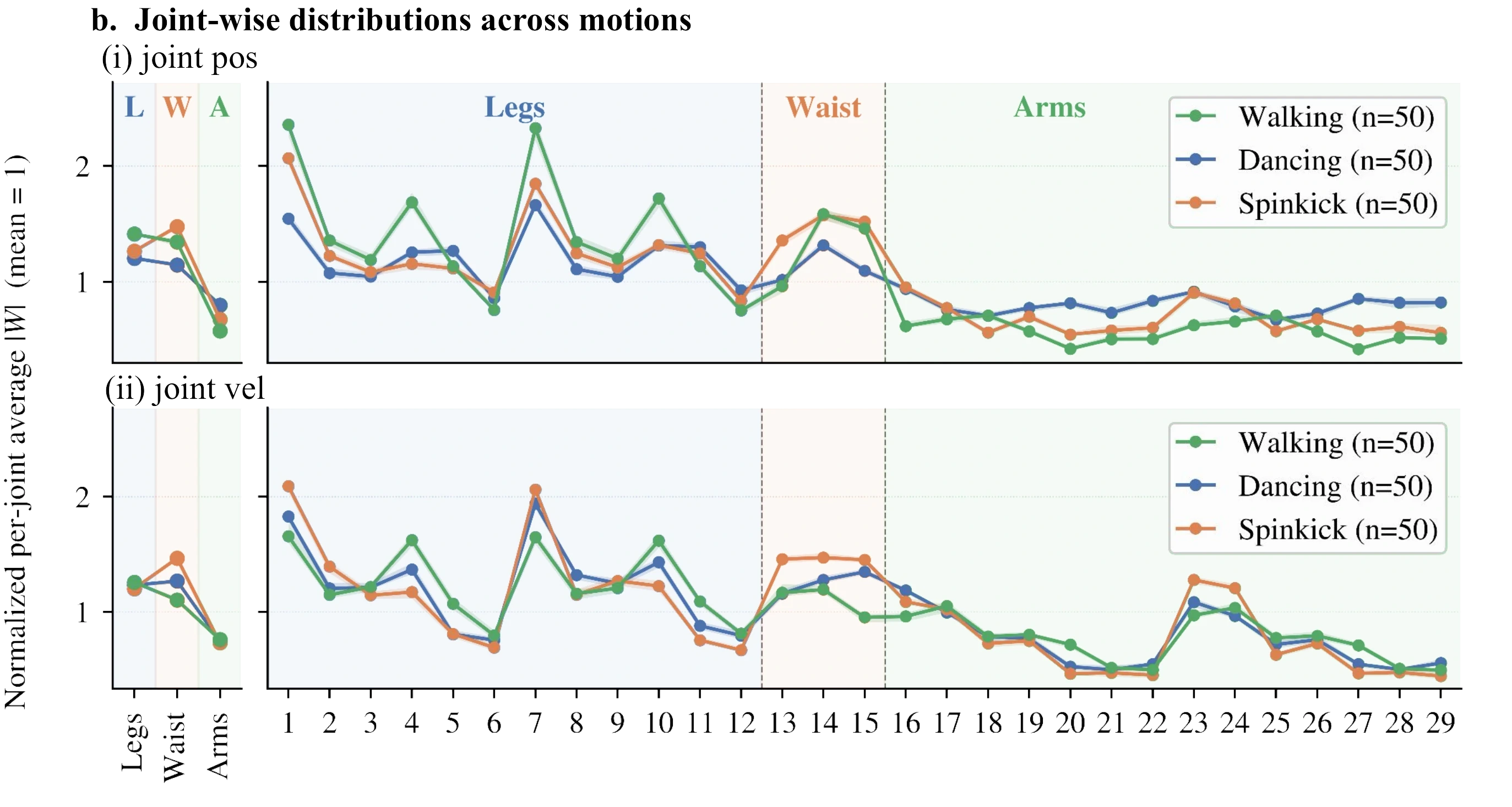
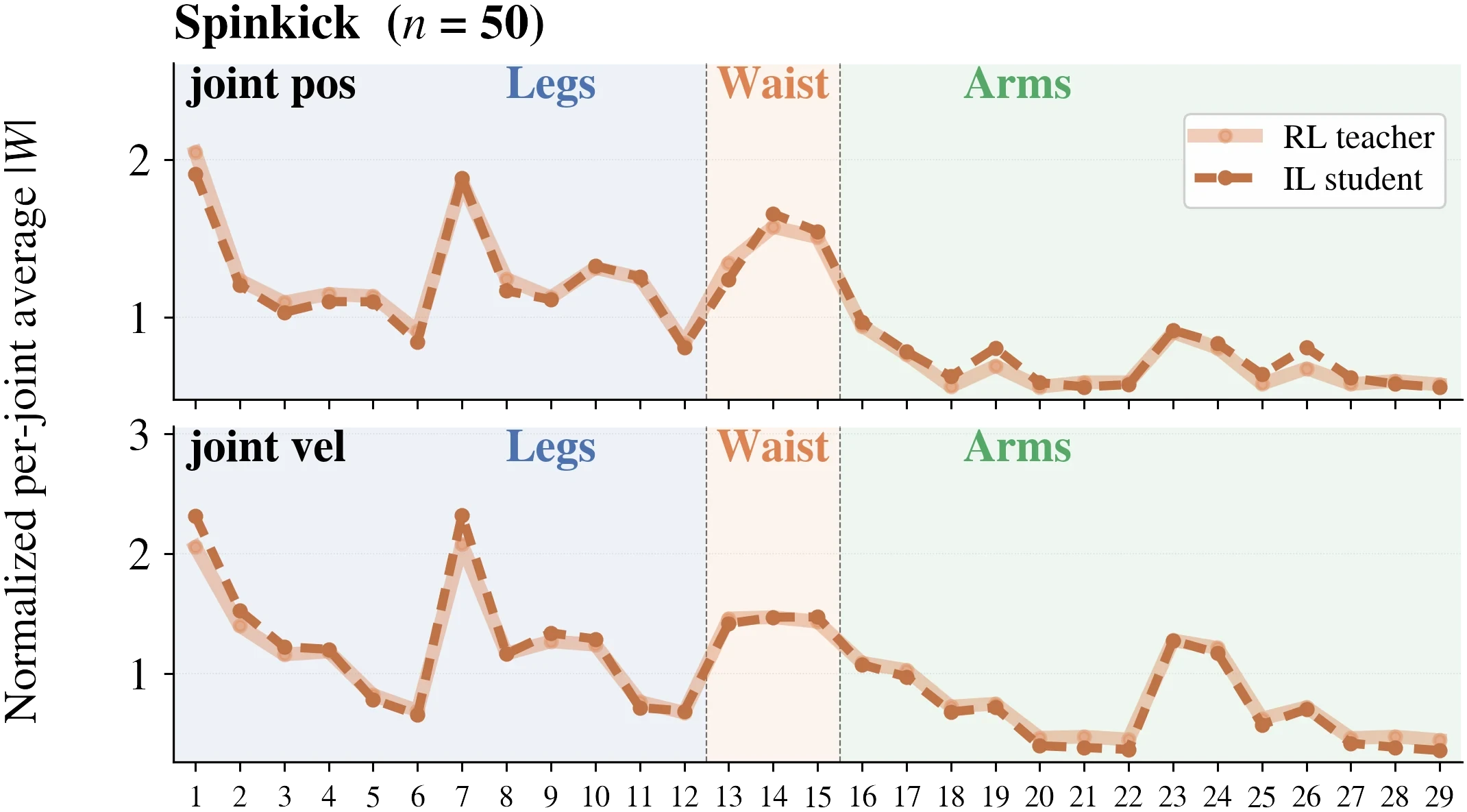
For those RL trained networks, we average the absolute first-layer weight over the
128 hidden nodes and 50 seeds to obtain a per-joint importance profile. The profile barely moves
between walking, dancing and spin kick. The network spends its first layer describing the
robot, not the motion.
Observation shows a structural principle in the first-layer
weights: the network assigns the greatest importance to the waist region and to joint indices 1
and 7, corresponding to the left and right hip pitch joints, which collectively define the pelvic
region. These are followed by the remaining joints in legs and then the arms. We therefore
hypothesize that the first-layer weight matrices capture a kinematic prior rather than
motion-specific knowledge. This interpretation aligns with findings in human motor control and
biomechanics showing that the trunk primarily provides postural stability, while the limbs are
responsible for mobility and motion execution.
Normalized per-joint average |W| for the joint_pos (top) and
joint_vel (bottom) input blocks, across 29 actuated joints ordered legs (12),
waist (3), arms (14).The 29 actuated joints of the input joint_pos, joint_vel and last_action
Index k is the position in the
joint_pos / joint_vel / last_action input blocks and in
the 29-d action output.
Kinematic prior in both RL and IL weight
The emergence of a kinematic prior raises a natural question: is that prior
intrinsic to the learned motion, or does it depend on how the network is trained? We therefore
analyze networks trained by imitation learning (IL) performing the same motions.
For each motion we distill an IL network from a pre-trained RL network. We roll
out the RL network in parallel environments to collect a buffer and distill the IL network by
offline regression, achieving a functionally equivalent network obtained through an
entirely different optimization process.
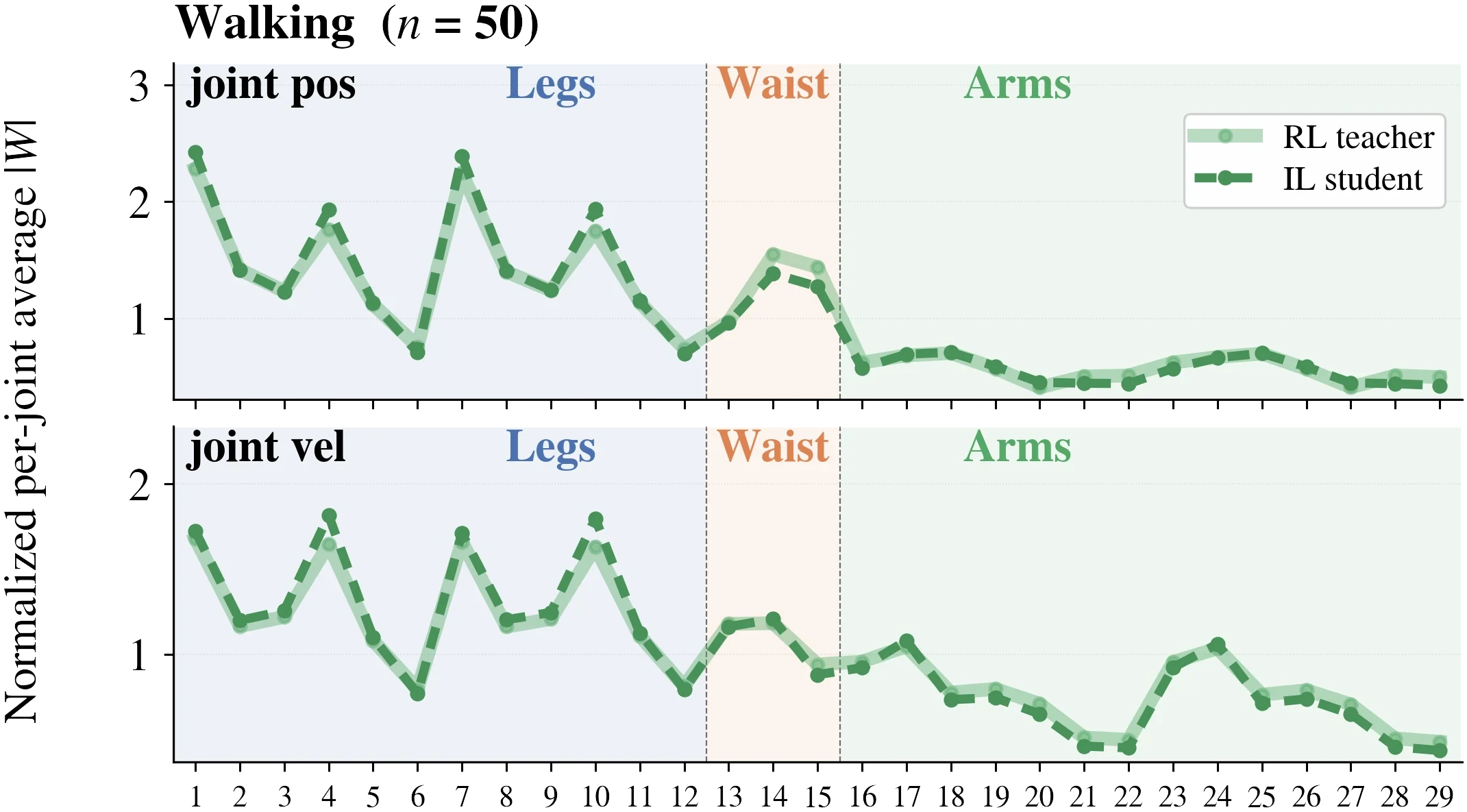
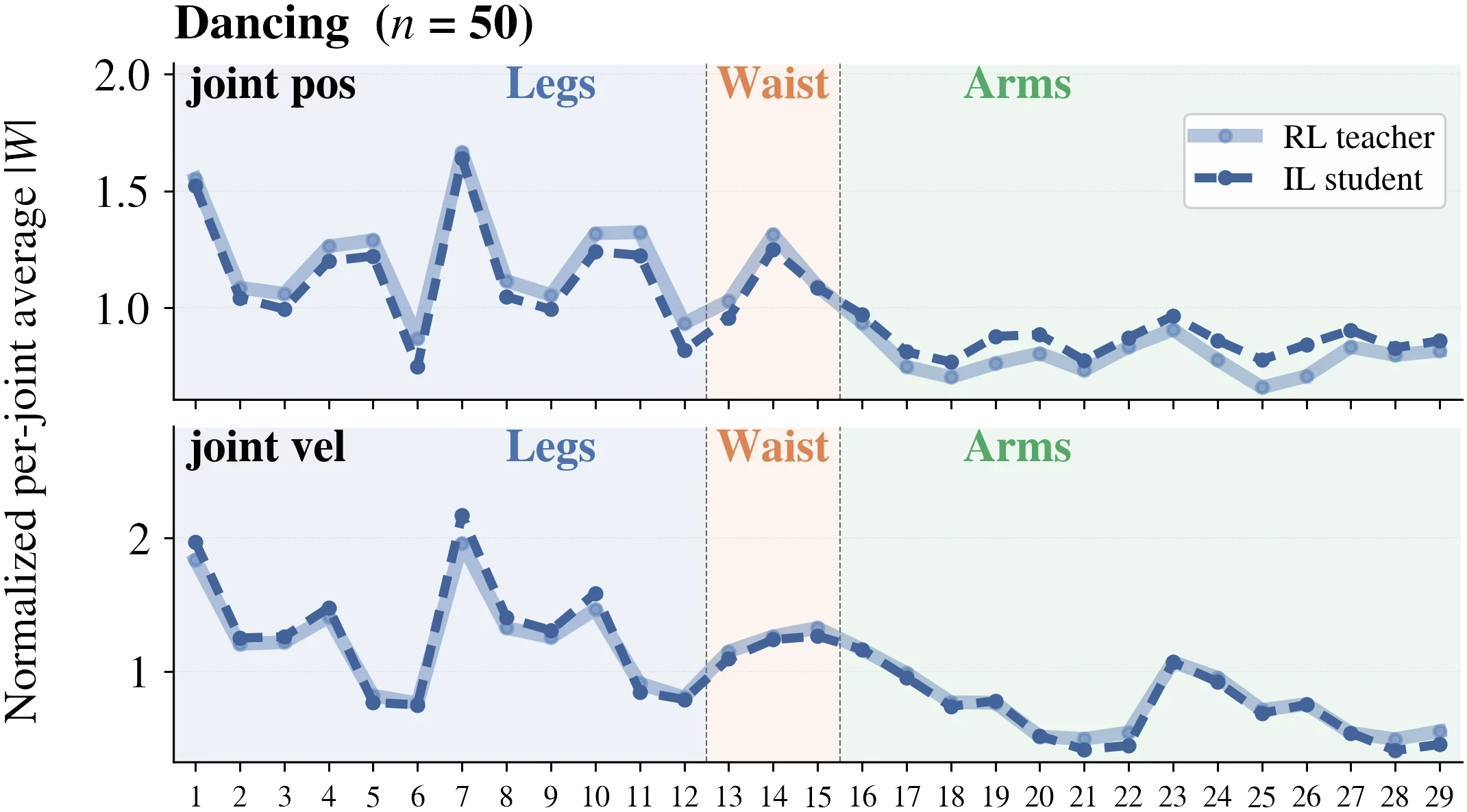
We illustrate the per-joint importance curves of RL and IL for all motions
separately, and the RL and IL curves nearly overlap. The heat maps tell the same story: switch
the explorer above to RL vs IL and the two matrices carry similar row structure, with the RL
weights simply running larger in magnitude.
The RL and IL networks are nevertheless not trivially connected in weight space,
and interpolating between them does not yield a functional policy. Therefore, the kinematic
prior is not specific to the RL optimization. It may instead reflect common knowledge
associated with the humanoid embodiment and the underlying motion kinematics.
Normalized per-joint average |W| by mean for each motion, averaged over 50 RL teachers and
their 50 distilled IL students. The solid and dashed curves largely overlap, indicating the
first-layer kinematic prior is preserved through distillation. Click any panel to enlarge.How the IL networks were distilled
A student MLP with identical depth, width, activations and parameter
naming is trained by mean-squared regression on a buffer of RL rollouts, with no environment
interaction and no reward. The student starts from the same initialization as its
teacher. Repeated independently for each teacher: 50 teacher–student pairs per motion.
Buffer
Nenv × T × R
Samples
Obs dim
Walking
1024 × 500 × 2
1,024,000
99
Dancing
512 × 892 × 2
913,408
154
Spin kick
512 × 232 × 8
950,272
154
Nenv is the number of parallel environments, T the episode
length in frames, and R the number of episodes collected per environment. The distilled
networks reach success rate and tracking error comparable to their RL teachers in
closed-loop simulation: functionally equivalent policies, reached by a different
optimization process.
Distillation setting
Value
Objective
MSE on the teacher's mean action
Optimizer
AdamW, weight decay 1 × 10⁻⁵
Learning rate
3 × 10⁻⁴ → 1 × 10⁻⁵ (cosine)
Batch size
4,096
Shared across all three motions.
Subspace similarity across motions
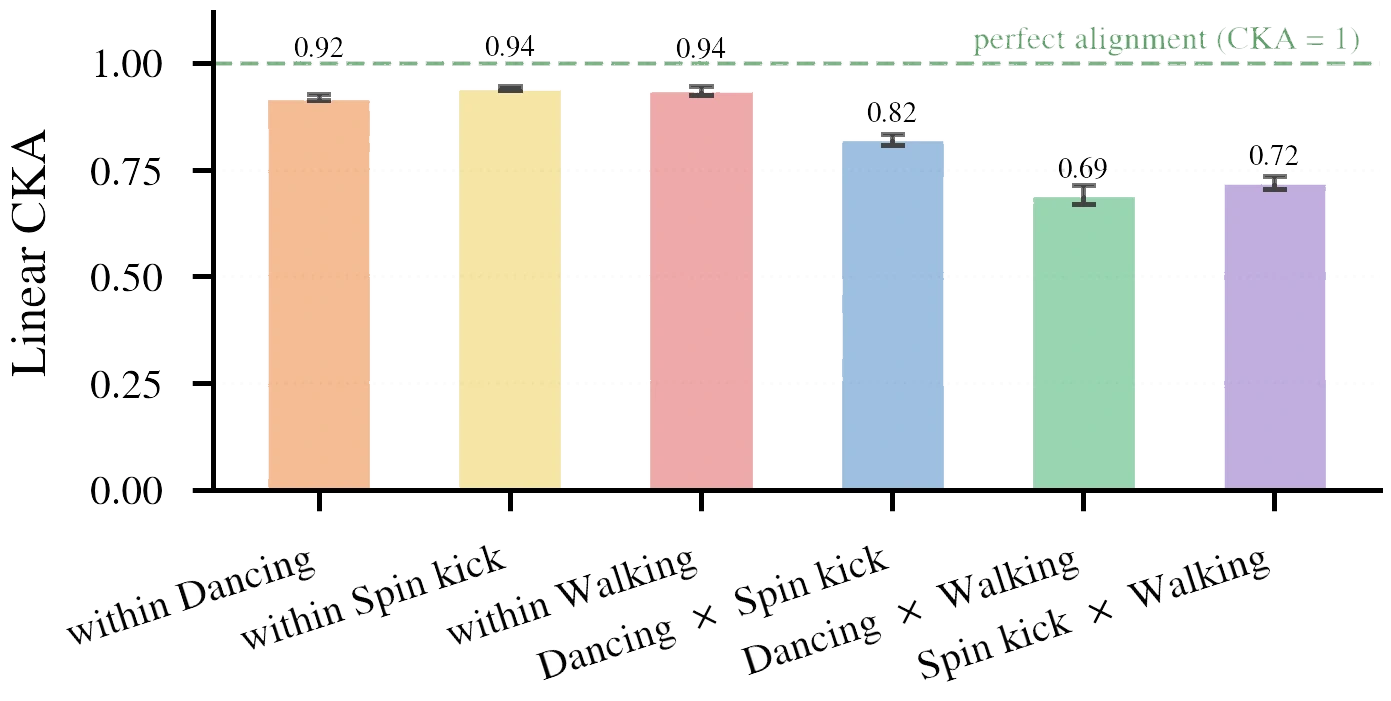
Linear CKA on the shared joint_pos and joint_vel inputs,
computed over the 128 hidden nodes' 58-dimensional weight vectors. The first three bars are
within-motion seed pairs; the last three are cross-motion pairs.
The first layer contains 128 hidden nodes, each defined by a weight vector
over the input dimensions. All three motions share joint_pos (29) and
joint_vel (29), so every hidden node carries a 58-dimensional weight vector
defined on the same inputs. We analyze the subspace those 128 vectors span, and ask whether
the subspace itself is shared across motions. Subspace similarity is measured with linear
Centered Kernel Alignment. CKA runs from 0 (unrelated) to 1 (identical); as a reference point,
two independently drawn Kaiming-initialized weight matrices reach about 0.5.
Within a motion, different random seeds converge to nearly the same subspace.
Across motions the similarity drops but is still above the initialization reference. The first
layer is therefore neither motion-agnostic nor motion-specific. A substantial shared
component is shaped by the G1's kinematics prior, and each motion introduces its own modulation
within that shared subspace.
Effect of domain randomization on weight space
Domain randomization is a key component of sim-to-real reinforcement learning, but
its effect is typically evaluated only through policy performance. We instead ask how it changes
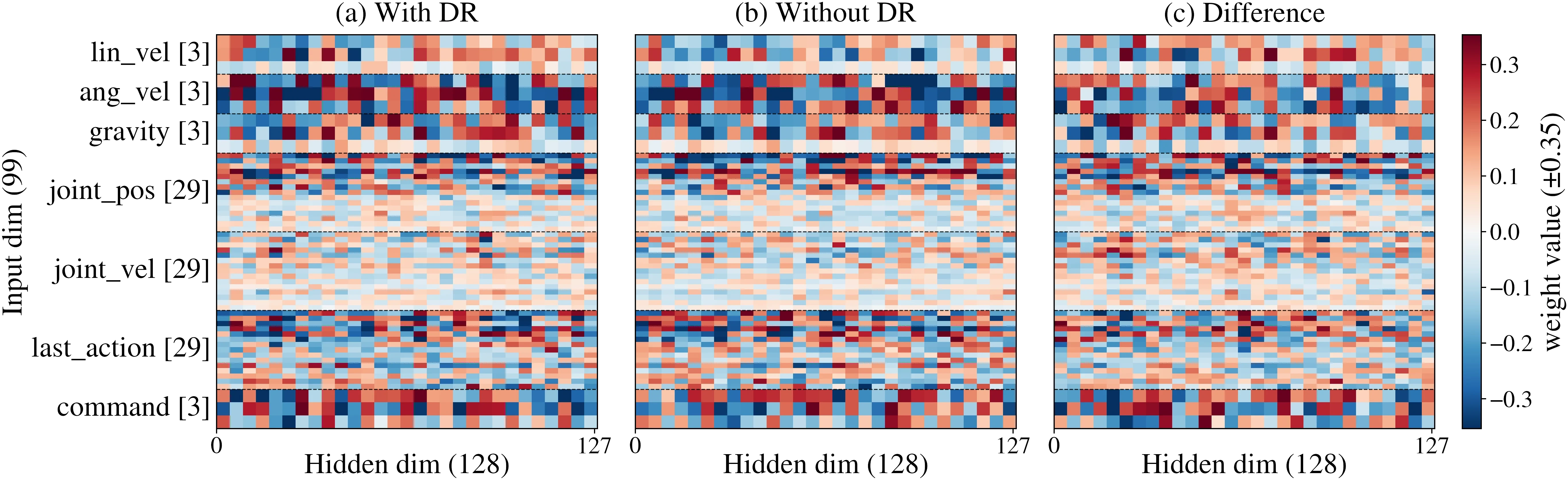
the weight space. For each motion we train two RL networks from the same initialization, one with
DR and one without, and compare their first-layer heat maps together with the element-wise
difference WDR − WwithoutDR.
The two networks look highly similar overall, yet their difference is substantial,
and the difference itself carries structure that resembles an RL-trained weight matrix rather than
noise. DR therefore reshapes the weights significantly while preserving their overall
distribution. The difference weights alone do not constitute a functional policy in simulation,
and linear interpolation between the DR and no-DR networks fails to produce functional
intermediate policies on any motion. The effect of DR cannot be represented as a simple linear
displacement in weight space; it is a structured reorganization accumulated throughout RL
training, leaving the motion's overall weight-space structure intact.
3 views · ← → to step through motions
First-layer weight heat maps for walking, from RL
networks trained from the same initialization: (a) with DR, (b) without DR, and (c) their
element-wise difference.What exactly is randomized in the DR runs
Term
Randomised quantity
Walking
Dancing
Sampling
Foot friction
Sliding friction coefficient of the foot geoms
U(0.3, 1.2)
U(0.3, 1.2)
per env
Torso CoM offset
Centre-of-mass position of the torso link, per axis
±(2.5, 2.5, 3.0) cm
±(2.5, 5.0, 5.0) cm
per env, per axis
Encoder bias
Constant offset on the measured joint positions
±0.015 rad
±0.010 rad
per env, per joint
BibTeX
@article{cheng2026modeling,
  title   = {Modeling and Understanding Neural Weights of Humanoid Policies with Diffusion},
  author  = {Cheng, Huixuan and Zhang, Bike and Sastry, Shankar and Sreenath, Koushil},
  journal = {arXiv preprint arXiv:2610.20606},
  year    = {2026}
}